
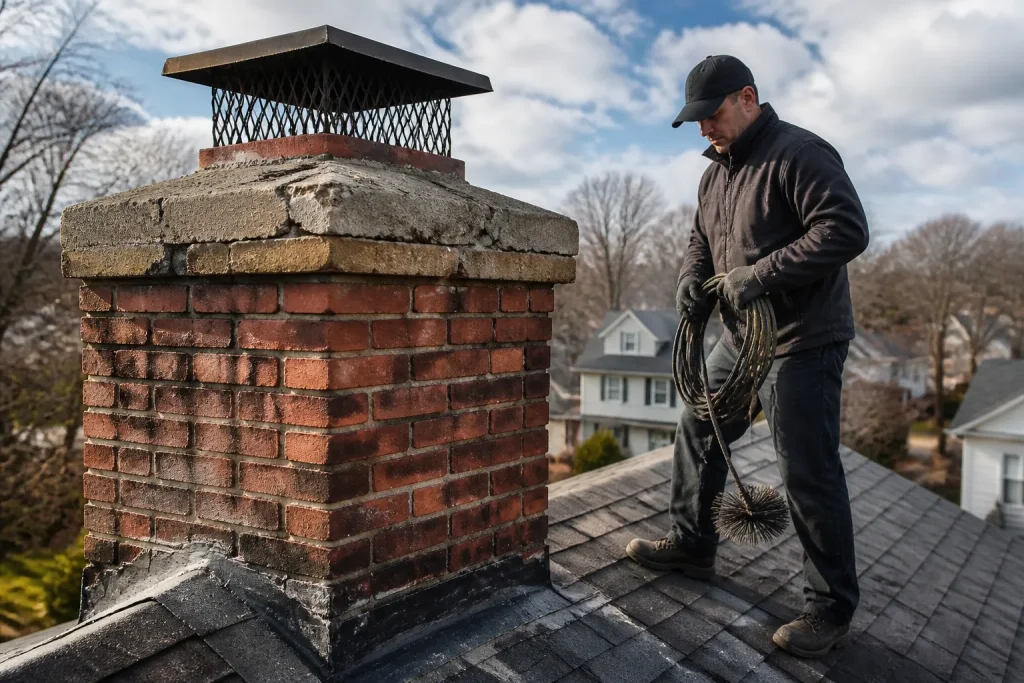
Chimney Sweep: Repair or Replace? How Bedford Park Homeowners Decide
The most expensive chimney mistake Bedford Park homeowners make isn’t skipping the annual cleaning. It’s paying to replace a component that could have been repaired for a fraction of the cost, or patching a component that was already well past the point where repair made economic sense. The decision isn’t intuitive, and it’s rarely explained well. A flue liner that looks perfectly intact from the firebox can be functionally failed at the top of the flue. A chimney with crumbling exterior mortar can be structurally sound where it counts. This guide walks through the variables that actually drive the repair-or-replace decision, so you can evaluate a contractor’s recommendation with clear eyes instead of relying on whoever you happened to call first.
If you’d rather have a trained eye look at it before you decide anything, call (866) 937-7520. We answer 24/7, and the estimate is free.
What Variables Actually Push a Chimney Toward Repair vs. Replacement?
A chimney is not one thing. It’s a set of systems stacked together: the firebox, the flue liner, the masonry shell, the crown, the cap, and the flashing where it meets the roof. Most repair-or-replace confusion comes from treating the whole chimney as a single unit when the decision usually belongs to one component at a time.
Three variables drive the call in almost every case we assess in Bedford Park:
- Extent of damage. Is the problem confined to a single component, or has it spread across systems? A cracked crown with a dry, sound flue is a repair. A failed liner with water-damaged masonry behind it is a larger conversation.
- Structural integrity of the masonry shell. Spalling brick and eroded joints on the exterior look alarming, but if the shell is plumb and the mortar can be repointed, the chimney is serviceable. A shell that’s leaning, bowing, or has lost bond is a different matter.
- Age relative to liner life expectancy. A clay tile liner in a mid-century Bedford Park house may be near or past its expected service life even if it hasn’t visibly failed yet. When the liner is at end of life and already showing damage patterns, resurfacing or relining usually beats waiting for a bigger problem.
The tell is whether the damage is isolated. Isolated damage favors repair. Damage that has jumped from one system into another is what pushes a decision toward replacement.
When Is HeatShield Resurfacing the Right Call, and When Do You Need Full Liner Replacement?
This is the question that separates a real assessment from a sales pitch, and it’s the one homeowners most often get wrong. HeatShield resurfacing is a professional system that rebuilds the interior surface of a clay tile liner from the inside, restoring a continuous, smooth flue. It works well on a specific set of conditions. It does not work on everything.
Resurfacing is typically appropriate when the liner’s problems are surface-level: cracked or spalled tiles, gaps at the joints, and erosion of the mortar between tiles, as long as the tiles are still in place and structurally intact. The system is designed for long-term restoration of a liner that’s still essentially there.
Liner damage patterns that disqualify resurfacing include:
- Missing or collapsed tile sections, where there is no substrate left to resurface over
- A flue that is offset, out of round, or significantly deteriorated in size through the run
- Tile separation or shifting that has broken the liner’s structural continuity
- A flue that has already been relined with a system that’s now failing
When tiles are gone, a full stainless liner from a brand like DuraFlex is the correct answer. It creates an entirely new flue inside the old one. There’s no honest way to resurface a liner that isn’t there.
How Do You Evaluate a Contractor’s Repair-or-Replace Recommendation?
Ask a simple question before you accept any recommendation: what does this company actually do? A contractor who only installs liners will find a reason you need a liner. A contractor who only sweeps and patches will tell you the problem is manageable. Neither is lying, necessarily, but both have a financial incentive that shapes what they’re looking for.
What you want is a company equipped to do both, so the recommendation comes from the condition of the chimney rather than the menu of services. We handle sweeping, chimney cap & crown work, repair, fireplace repair, and inspection as separate services for exactly this reason. When resurfacing is the honest call, we use HeatShield. When a liner needs replacing, we install DuraFlex. The material follows the diagnosis, not the other way around.
Questions worth asking any contractor in Bedford Park:
- Can I see the camera footage of the inside of the flue?
- What specifically is damaged, and what’s still sound?
- If we repair this, what’s the realistic lifespan before the next intervention?
- If we replace it, what am I getting that a repair wouldn’t provide?
A recommendation that can’t survive those four questions isn’t ready to act on.
The Ten-Year Cost Math: Why Patch Repairs Often Lose
Homeowners tend to compare the cost of the repair in front of them against the cost of the replacement in front of them, then pick the cheaper number. That comparison is incomplete, and it’s the source of most of the regret we see.
The better method is to add up what each path costs over a longer horizon, because a chimney that needs work doesn’t stop needing work.
- The patching path: A modest repair now, a second repair in a few years as the original problem spreads, water intrusion damage to the surrounding masonry in between, and eventually the replacement anyway. The total is the original replacement cost plus everything spent avoiding it.
- The replacement path: A larger upfront investment that ends the cycle, provided the surrounding systems (crown, cap, flashing) are in condition to support the new component.
There are real cases where patching is the right financial call. A structurally sound chimney with an isolated cracked crown is not a candidate for a rebuild, and nobody should tell you otherwise. But when the same component has been repaired twice and is failing a third time, the math has already told you the answer. A larger upfront repair investment usually outperforms a string of patch repairs once you’re past the second attempt on the same problem.
What a Level 2 Inspection Camera Report Should Show You
Verbal assessments are not sufficient to make a repair-or-replace decision. You cannot weigh two options if the evidence for both is a description you can’t see. A Level 2 inspection is the threshold for any decision involving a change to the chimney system, and the report is what makes the decision defensible.
What you should see:
- Camera footage through the full flue run, from the top to the firebox, not a few still photos of the worst spots
- Identified locations of each defect, so you can connect the damage to a specific point in the chimney
- An assessment of the liner, the firebox, the crown, the cap, and the flashing, since the decision often depends on how these interact
- A written summary distinguishing what needs to be addressed now, what can wait, and what should be monitored
If something can safely wait, a good inspection says so. A chimney inspection isn’t a sales funnel, and the report should read like a diagnosis, not a proposal. That’s why we list inspection as a standalone service rather than an upsell.
When to Call a Pro
Some of this you can observe yourself. Cracked mortar at the crown, a missing cap, water staining on the ceiling near the chimney, or a firebox that’s pulling smoke into the room are all reasons to get an assessment before the heating season starts. What you can’t do yourself is see the inside of the flue, and that’s where the repair-or-replace call actually gets made.
Chimney work also carries real risk. The interior of a flue is a confined space, and exterior masonry work happens at height. We don’t recommend climbing a roof to look at a cap or reaching into a firebox to probe a liner. Call a trained technician instead: chimney repair decisions depend on what the camera shows, and that’s the professional’s job.
Related services in Bedford Park: chimney cap & crown for water intrusion and cap replacement, chimney repair for structural and masonry work, and chimney sweep for the annual cleaning that catches problems early.
The Bottom Line
Repair makes sense when the damage is confined to one component and the masonry shell is sound. Replacement is the right call when a component has reached the end of its service life, when damage has spread across systems, or when you’re on your third repair of the same problem. Resurfacing with HeatShield works on a damaged-but-intact liner; a full DuraFlex reline is the answer when the liner is gone. And the whole decision should rest on a camera report you can see, from a company that’s equipped to recommend either path honestly.
If you’re in Bedford Park and need help working through this, Chimney Sweep Bedford Park offers free estimates. Call (866) 937-7520. We answer 24/7. Fast dispatch from 7am to 7pm, Sunday through Friday.
Frequently Asked Questions
Yes, often. If the clay tiles are still in place and the damage is limited to cracks, spalled surfaces, and eroded joints, HeatShield resurfacing can restore the interior of the liner without removing it. If tiles are missing, collapsed, or shifted out of alignment, resurfacing has nothing to bond to and a full liner is the correct choice.
You know by looking at the camera footage from a Level 2 inspection. Isolated damage to one component on a structurally sound chimney points to repair. Damage that has spread across the liner, masonry, and crown, or a component already at the end of its service life, points to replacement.
It depends on where the damage sits. A chimney with original brick, sound mortar joints, and a failing crown is worth repairing, because the expensive part (the shell) is still good. A chimney with a deteriorated liner, water damage behind the masonry, and a failing crown is usually a replacement conversation.
Camera footage through the full length of the flue, the location of each defect, an assessment of the liner, firebox, crown, cap, and flashing, and a written summary separating what needs attention now from what can safely wait. If a contractor can’t show you the footage, don’t make a repair-or-replace decision on their word alone.
Written by the team at Chimney Sweep Bedford Park.
Need Chimney Cleaning Help?
Call Chimney Sweep Bedford Park - the local pro we connect you with is licensed and insured, here with fast help in Bedford Park.
(866) 937-7520